

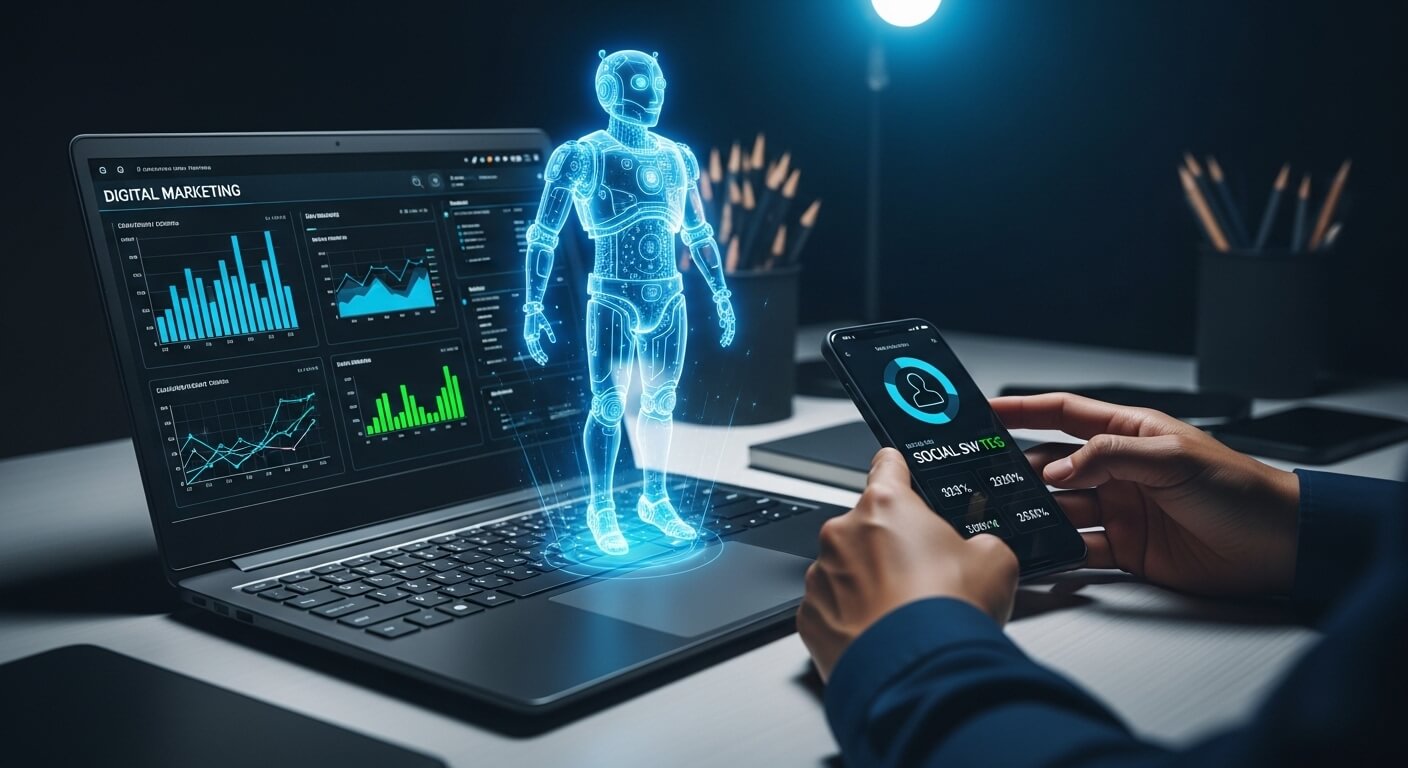
A few years ago, the idea that artificial intelligence (AI) could write blog posts, design logos, or even manage ad campaigns sounded like science fiction. Today? It’s reality.
From AI-generated content to automated customer journeys, AI is rapidly transforming the landscape of digital marketing and it’s doing it faster than most of us ever expected. Tools like ChatGPT, Midjourney, Jasper, and countless others are helping businesses scale their marketing efforts in ways that would’ve taken massive teams just a decade ago.
As a result, there’s a growing sense of uncertainty even fear in the air, especially among marketers. Will AI eventually replace the human roles behind digital marketing jobs? Is it the beginning of the end for marketing as we know it, or just the next evolution in the field?
If you’re building a digital marketing business, working as a freelancer, or even just curious about the future of your career in digital marketing, you’ve probably asked yourself some version of this question:
“Will AI replace digital marketing?”
It’s a fair question. But here’s the thing: the answer isn’t as simple as “yes” or “no.” Like most shifts in technology, the rise of AI presents both a threat and an opportunity. Some tasks will be automated. Some roles will evolve. But there’s also a new layer of possibility a chance to work with AI rather than against it.
In this post, we’re going to unpack that central question. We’ll look at how AI and digital marketing intersect, where the real value of human marketers lies, and how you can future proof your role in a world of intelligent tools.
The truth? It lies somewhere in the middle.
2. Will AI replace Digital Marketing? The Rise of AI in Digital Marketing
Not too long ago, digital marketing was dominated by human-driven tasks writing blog posts, designing visuals, analyzing spreadsheets, scheduling content, running A/B tests, and manually tweaking ad campaigns. Every click, every campaign, every conversion was closely tied to a marketer’s time and attention.
Then came AI.
Today, AI in digital marketing is no longer a futuristic concept. It’s happening everywhere. From large corporations to solo entrepreneurs, businesses are integrating AI tools into their marketing workflows at a staggering pace. And it’s not just about saving time (though it does that, too); it’s about doing things better, faster, and smarter.
AI-Powered Content Creation
Let’s start with content the backbone of most digital marketing businesses. Tools like ChatGPT and Jasper are helping marketers generate blog drafts, email sequences, product descriptions, and even social media captions in minutes. AI can analyze tone, adjust for SEO, and offer multiple variations in seconds. What once took a full day can now be done over coffee.
That doesn’t mean human writers are obsolete far from it. But AI is changing the digital marketing job description. Instead of writing from scratch, marketers are becoming editors, strategists, and brand voice protectors, working alongside AI to craft content that connects.
Smarter Ads, Better Targeting
In advertising, platforms like Google and Meta now use machine learning to manage budgets, placements, and bidding strategies all with little human input. Google’s Performance Max campaigns, for instance, use AI to deliver the right ad to the right person at the right time, across multiple channels.
This isn’t just automation; it’s adaptive intelligence. AI doesn’t just follow instructions it learns from data and adjusts in real-time. That’s a game-changer for anyone running a digital marketing business that relies on paid ads.
Automation Tools That Scale
AI also powers tools that automate tedious but essential tasks:
- Email list segmentation
- Predictive lead scoring
- Chatbots for 24/7 customer support
- Personalized content recommendations
- Analytics dashboards that explain what’s happening
All of this gives marketers back something precious: time. Time to focus on creative strategy, brand storytelling, and big-picture thinking areas where human marketers still shine.
AI and the Future of Digital Marketing Jobs
Naturally, this rise in AI-led tools has sparked conversations around careers in digital marketing. Will jobs disappear? Will AI replace marketers entirely?
The short answer is it’s not that black and white.
Yes, some entry-level or repetitive tasks are being absorbed by AI. But at the same time, new roles are emerging like AI content strategist, prompt engineer, marketing technologist, and data-driven creative director. These jobs didn’t even exist five years ago.
So no, AI isn’t replacing digital marketing. It’s reshaping it. It’s replacing some functions, but it’s also enhancing others, allowing marketers to focus on areas where humans still outperform machines: creativity, empathy, strategy, and nuance.
What AI Can (and Can’t) Do in Digital Marketing
AI can do a lot. Let’s be real it’s impressive. It can write, analyze, schedule, recommend, and even “think” (in a very technical sense). But as advanced as it is, AI still has clear limits, especially when it comes to the core of digital marketing: understanding people.
Let’s break it down.
What AI Can Do and Does Well
1. Analyze Massive Amounts of Data
AI thrives on data. It can scan thousands of data points from website traffic, email campaigns, and customer behavior in seconds something that would take a human team days. This means smarter decisions, faster.
Whether you’re running a digital marketing business or working in a larger team, having AI crunch the numbers gives you the insights you need to improve campaigns without drowning in spreadsheets.
2. Automate Repetitive Tasks
AI is perfect for things that are repetitive and rule-based:
- Scheduling social media posts
- Personalizing email content based on user behavior
- Generating product descriptions for large eCommerce sites
- Recommending articles or products based on past behavior
This kind of automation not only boosts productivity but also allows marketers to scale their efforts which is essential in today’s fast-moving digital world.
3. Create Content (Sort Of)
AI can write blog posts, emails, ads. But the truth is, it often needs human guidance to be truly effective. It can produce decent first drafts, and it’s great for brainstorming, summarizing, or localizing content. But AI lacks an understanding of context, humor, irony, and emotion all of which matter a lot in marketing.
What AI Can’t Do and Why It Matters
Despite its strengths, AI has serious limitations. These are the reasons why AI replacing digital marketing entirely is highly unlikely at least any time soon.
1. Understand Human Emotion and Nuance
AI doesn’t “understand” emotions. It can mimic emotional tone, sure but only based on patterns it’s seen before. When it comes to crafting a brand message that really connects with your audience’s hopes, fears, or desires, humans still lead.
Think of a brand like Nike. Their messaging isn’t just well-written it’s emotionally charged, purpose-driven, and culturally aware. That’s not something you can get from an algorithm.
2. Think Strategically
AI can support strategic decisions by analyzing trends or forecasting outcomes, but it doesn’t create strategies from scratch. It doesn’t have goals, instincts, or deep market knowledge the way a seasoned marketer does.
It won’t say, “Let’s take this bold approach to reposition the brand” because boldness isn’t something AI is capable of. It optimizes; it doesn’t innovate.
3. Interpret Context
Context is everything in marketing. A joke that works in one country might fall flat in another. A campaign that kills it on TikTok might feel cringey on LinkedIn. AI can’t always tell the difference. It lacks the cultural, social, and psychological understanding that humans use to make those calls instinctively.
4. Build Trust
Marketing is about relationships. And relationships are built on trust, authenticity, and values. While AI can help with personalization, it doesn’t have integrity. It doesn’t understand your brand’s mission. It doesn’t care about your audience.
People trust people, not bots.
Why AI Matters for Your Career in Digital Marketing
Here’s the bottom line: if your role is purely technical or task-based, AI might change the way you work or take over parts of your job entirely. But if you’re a marketer who brings creativity, empathy, critical thinking, and strategy to the table, you’re not being replaced.
You’re being empowered.
In fact, the smartest move right now is to learn how to use AI as a tool so you can do your job faster, better, and with more impact. That’s how you turn this “threat” into a massive opportunity.
AI as a Tool: How Marketers Can Leverage It
When digital marketers first started hearing about AI, most of us had the same gut reaction: “Cool… but will it replace me?” It’s understandable. Headlines promised fully automated content, smarter ad targeting, and customer service bots that never sleep. For anyone with a digital marketing job, that sounded like a warning siren.
But here’s the truth: AI doesn’t need to be the enemy. In fact, when you stop thinking of it as a threat and start seeing it as a tool, everything changes.
Let’s say you’re managing content for a digital marketing business. You’ve got blog posts to write, social media calendars to fill, product emails to send, and an endless list of ideas you haven’t had time to work on. It’s overwhelming and creativity doesn’t always show up when you’re juggling deadlines.
That’s where AI steps in not to take over, but to assist. Maybe you use a tool like ChatGPT to brainstorm content angles or write the first draft of a blog post. You still shape the message, add the personality, and bring your brand’s voice to life. But AI helps you move faster. It removes the pressure of starting from scratch.
Think of it like having a junior copywriter who never sleeps one that’s always available to bounce ideas off, generate headlines, or find the right words when you’re stuck.
And it’s not just about content. Let’s talk data, that part of marketing many of us quietly dread. AI can pull insights from massive amounts of information in seconds. You no longer have to manually sort through reports or guess which campaign is performing best. AI tools can show you trends, make predictions, and even recommend next steps.
Imagine logging into your dashboard and seeing not just numbers, but a clear story about what your audience is responding to, and what you should do next. It’s like having a strategist in your corner, guiding your next move all powered by machine learning.
And then there’s personalization. In the past, marketing to thousands of people meant sending one-size-fits-all messages. But now, with AI, you can create tailored experiences for every customer from product recommendations to email content. You’re no longer just sending messages; you’re starting conversations.
Even the customer experience side of marketing is shifting. AI-powered chatbots now handle FAQs, qualify leads, and provide instant support, freeing you up to focus on building strategy, not answering the same question for the hundredth time. These tools don’t replace your voice they extend it, 24/7.
What’s exciting is how all of this is shaping careers in digital marketing. We’re seeing new roles emerge like AI content strategist, automation specialist, even prompt engineer. These aren’t futuristic job titles, they’re real positions, hiring right now. It’s not about being replaced by AI but about evolving with it.
This shift doesn’t mean you have to become a data scientist or a coder. But it does mean learning how to work alongside AI. Knowing how to guide it. Knowing where to step in and add the human touch it will never have.
Because here’s what AI can’t do: it can’t understand your audience’s emotions. It can’t see the big picture the way you do. It doesn’t dream up bold campaign ideas or tell a story that gives someone goosebumps. That’s still your job and always will be.
AI doesn’t remove the need for marketers. It amplifies our ability to do what we do best. AI won’t replace you. But a marketer who knows how to use AI might.
It’s the same pattern we’ve seen with every major tech leap from the internet to social media to mobile. Those who adapted thrived. Those who resisted fell behind.
AI is no different. It’s just the next evolution.
Is It a Threat? The Real Risks
Let’s not sugarcoat it, AI in digital marketing does bring risks. As exciting as the possibilities are, we’d be doing ourselves a disservice by ignoring the very real concerns professionals are feeling. The fear isn’t irrational. It’s rooted in what we’re already seeing happen.
Some of the most common entry-level tasks in a digital marketing job writing short-form content, scheduling posts, pulling basic reports are now being handled by AI tools. What once required a junior assistant, or a freelance contractor can now be done by an algorithm in seconds.
If you’re just starting a career in digital marketing, that can feel like a punch to the gut.
And it’s not just the junior roles. Entire agencies are streamlining services thanks to automation: AI-generated ad copy, automated lead scoring, and campaign optimization with minimal human input. For someone trying to build a digital marketing business, it raises the obvious question: will AI replace digital marketing entirely? The answer isn’t as simple as yes or no. AI can handle repetitive tasks, but it cannot replace strategy, creativity, or human intuition.
These shifts have started to change hiring patterns too. Recruiters are now looking for marketers who are AI-aware people who don’t just know marketing, but also understand how to operate, train, or supervise AI systems. Many beginners worry, will AI replace digital marketing jobs for entry-level roles? The truth is, automation may handle routine tasks, but human insight, brand intuition, and creative problem-solving remain essential. Marketers who stay static risk being left behind.
Then there’s the issue of trust. As AI tools generate content and run customer interactions, there’s a growing concern around authenticity. Can audiences tell when they’re reading AI-written content? Does it matter to them? What happens when everyone’s using the same tools, the same prompts, the same templates? Professionals often ask, will AI replace digital marketing work that requires creativity and empathy? Again, the answer is no but only if you actively use AI as a tool rather than a crutch.
There’s also the ethical dimension. AI, by nature, learns from data but not all data is clean or fair. Biases baked into training sets can creep into marketing decisions, especially in ad targeting or customer segmentation. Without human oversight, this can lead to unintended discrimination or tone-deaf messaging.
And let’s not forget privacy. The more personalized we get, the more we rely on user data. AI makes it easier to track behavior, predict actions, and tailor content. But with that power comes the responsibility to use data ethically and transparently something no algorithm can guarantee on its own.
So yes, there are threats. The fear that AI might replace digital marketing in its current form isn’t completely unfounded. But the bigger risk? It’s not adapting. Not learning. Not preparing.
Here’s the hard truth: AI won’t take your job. But a marketer who knows how to use AI effectively might.
The marketers who are learning how to pair their creative intuition with machine intelligence, who understand how to maintain a brand’s humanity in an automated world they’re the ones rising above the noise. They’re building stronger strategies, driving better results, and doing it in half the time. So, while AI can feel like a threat, the real danger is in resisting it. And the ultimate answer to will AI replace digital marketing is this: it won’t replace it but it will redefine what it takes to succeed
The Future of Digital Marketing: Human + AI
So, where does all this leave us?
If you’ve been in marketing long enough, you’ve seen your fair share of “game-changing” trends. Social media. Influencer culture. Voice search. Video. Mobile-first everything. Every time, the same fear surfaced: “Will this change everything?” And every time, the answer was both yes… and no.
AI is no different.
It is changing the game not by wiping the board clean, but by reshaping the rules. And here’s the truth: the question isn’t whether AI will replace digital marketing, it won’t. Instead, we’re moving toward a future where AI and digital marketing are deeply integrated. And the real winners? They’ll be the marketers who know how to play both sides: human and machine.
Imagine the possibilities.
You’re not bogged down by data analysis because AI already flagged the key insights for you. You’re not scrambling to draft an email campaign from scratch because AI offered five solid concepts to choose from. You’re not guessing which audience segment to prioritize because predictive analytics showed you who’s most likely to convert.
Now, instead of spending your time on busywork, you’re spending it where it counts crafting brand stories, testing bold ideas, developing strategy, and connecting emotionally with your audience.
This is what the future of a digital marketing business looks like: humans making high-impact decisions, guided by AI that handles the heavy lifting.
But make no mistake, human judgment still matters. In fact, it matters more than ever.
In a world where everyone has access to the same tools, what sets you apart is not what you use, but how you use it. Your creative instinct. Your empathy. Your brand intuition. AI might help you get your message out faster, but only you can make it resonate.
The next wave of careers in digital marketing will go to the creatives who embrace AI, not fear it. The strategists who understand both the technology and the human behavior behind it. The professionals who can pair insight with innovation.
And guess what? That could be you.
Because you’re not here just to keep up, you’re here to lead, adapt, and grow.
Evolve With AI, Don’t Compete Against It
AI is not your replacement. It’s your resource.
If there’s one thing to take away from this post, it’s that the rise of AI isn’t the end of digital marketing it’s the next phase of it. And that phase still needs you, your ideas, your creativity, your voice, and your ability to connect with real people in real ways.
Yes, the landscape is shifting. Some roles will change, others will fade, and entirely new ones will be born. But this isn’t a moment to fear it’s a moment to prepare.
So instead of asking, “Will AI replace my digital marketing job?” a better question might be:
“How can I make AI work for me?”
The marketers who thrive will be those who lean in who learn the tools, adapt their skills, and stay curious. Because AI can do a lot, but it can’t replace a creative, emotionally intelligent, forward-thinking human.
And if you’re ready to take that next step, we’ve got something for you.
Sign up for our free webinar: How to Use AI in Digital Marketing
We’ll Walk you through practical tools, real use cases, and how to start integrating AI into your business.
The future of digital marketing isn’t AI vs humans. It’s AI + humans.
Let’s learn how to grow together.